Tagliatelle with Bolognese Ragù
The authentic ragù alla bolognese, whose official recipe was registered with the Bologna Chamber of Commerce in 1982. Coarsely minced beef and pancetta gently browned in a soffritto, deglazed with white wine, then slowly simmered with a little tomato and finished with milk for a velvety, deep-flavoured sauce. Served the proper Emilian way over fresh egg tagliatelle — never spaghetti.
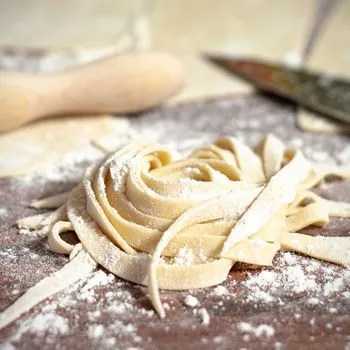
- prep 25 min
- cook 150 min
- total 175 min
- serves 4
- intermediate
- Italy
Ingredients
- 400 g Egg tagliatelle
- 400 g Ground beef
- 150 g Pancetta
- 1 medium Carrot
- 1 medium Onion
- 1 stalk Celery
- 150 ml White wine
- 200 g Tomato passata
- 1 tbsp Tomato paste
- 150 ml Milk
- 250 ml Beef broth
- 20 g Butter
- 2 tbsp Olive oil
- 60 g Parmesan cheese
- 1 to taste Salt
- 1 to taste Black pepper
Steps
- Finely dice the carrot, onion and celery to make a soffritto.
- In a heavy pot or earthenware casserole, melt a knob of butter with a splash of olive oil over low heat, add the finely chopped pancetta and let it render gently for 3–4 minutes.
- Add the soffritto and cook over low heat for 8–10 minutes, stirring often, until the vegetables are soft, golden and sweet but not coloured.
- This slow base is the backbone of the ragù's flavour.
- Raise the heat to medium-high and add the coarsely minced beef.
- Break it up with a wooden spoon and let it brown well for about 10 minutes, until any released liquid has evaporated and the meat sizzles and takes on colour.
- Pour in the white wine and let it evaporate completely, scraping the bottom of the pot — you should no longer smell alcohol, about 4–5 minutes.
- Stir in the tomato passata and tomato paste with a little hot broth.
- Season lightly with salt and pepper.
- Bring to a bare simmer.
- Lower the heat to the gentlest simmer, partially cover, and cook for at least 2 hours (ideally 3), stirring now and then and adding warm broth whenever the sauce gets too dry.
- The ragù should barely bubble.
- About 30 minutes before the end, pour in the warm milk and stir it in.
- It softens the acidity and gives the sauce its characteristic velvety texture.
- Adjust salt and pepper, then keep the ragù warm.
- Cook the fresh egg tagliatelle in plenty of salted boiling water until al dente, just 2–3 minutes for fresh pasta.
- Drain, keeping a little cooking water.
- Toss the tagliatelle directly in the pot with the ragù over low heat for a minute, loosening with a splash of pasta water if needed.
- Serve at once with grated Parmigiano Reggiano.
Tips
- The official 1982 recipe specifies coarsely minced beef, not finely ground — texture matters. A mix of beef and a little pork makes it richer.
- Never let the ragù boil hard; a long, lazy simmer is what develops the deep flavour. Patience over heat.
- Always pair with fresh egg tagliatelle, never spaghetti — the porous, rough pasta clings to the sauce as Emilians intend.
≈ 680 kcal · 34 g protein · 62 g carbs · 31 g fat — per serving, estimate